Showing posts with label Anatomy. Show all posts

Tuesday, February 21, 2012

The Eyes Have It

If someone wanted to take my horses they could just walk up, open the gate, and walk off with them.  I don't ever worry about that though.  Mostly because they would have a hard time getting them off of the property (good luck getting them in a trailer without a fuss!), but also they are just your average backyard horses.  Priceless to me but no one else.   If they were worth tens of thousands of dollars then I might be a little more concerned about having a means of identifying that they were mine.

Racing is a big money industry and consequently horses do get stolen.  Most breeds of race horses in North America are required to have a lip tattoo before their first race for ID purposes. Ouch!

Branding is another means of easy ID.  Horses can be either hot branded or freeze branded. Neither one seems like much fun to me!
Most people are familiar was hot branding from old cowboy movies.
Hot Branding
 A branding iron is heated red hot and applied to the skin long enough to create a permanent, hairless mark. Some breed associations require hot branding for registration.
Trakehner Hot Brand
Holsteiner Hot Brand

 Freeze branding is done by cooling the branding iron with liquid nitrogen.  The branding site is shaved to get better contact with the skin and the area soaked with alcohol before the iron is applied for several seconds.  This process damages the pigment in the hair cells and the hair on a dark colored horse will become white.
Freeze brand  on a dark colored horse

For light colored horses the iron is held in place slightly longer to eliminate the hair follicle all together and the dark skin will show through.   This video shows the process:
It is supposedly less painful to the horse (this horse doesn't seem to mind), but anyone who has had liquid nitrogen burn their skin knows that it is painful after the fact.

I recently read an article about a new type of identification called eye D  which involves simply taking a picture of the horse's eye with a special camera.  The pictures undergo computer analysis that focuses on the contours of the corpora nigra (the brown globby stuff) in the iris which are as unique as fingerprints. 
Corpora Nigra
The horse's information and eye scan are stored in a database and can be retrieved at any time, similar to micro-chipping dogs and cats. This is so much less invasive than anything else that in currently being used to identify our horsey friends.  I hope this technology takes off!

Monday, February 6, 2012

My Little Hay Burners

As I have mentioned before I am not a big fan of blanketing my horses.  I believe in letting them be as nature intended.  I do, however, like to do a few things to help them stay warm in the winter.  I like to let them stay outside at night in the nice weather, but as the the weather turns colder I lock them in their stalls.  I'm not sure if it makes any difference the them, but it makes me feel better. 

I also like to feed them extra hay, especially at night. The amount of extra hay depends on how cold it is supposed to get.  I give them more at night for two reasons. One, it gives them something to do while they are stuck in their stalls and two,  they are in a small space and are not moving around as much so they are not as warm.

Horses use hindgut fermentation as an "internal furnace" to help them stay warm.  After food leaves the stomach it passes through the small intestine, which is about 70 feet long and can take up to 90 minutes to get through.  Most of the warming process occurs in the hindgut, cecum, and large and small colons. These organs are designed to slow the passage of food so that plant fibers have time to break down.  This process can take up to 72 hours.  Roughage, like hay or grass, take longer to breakdown than grain and create a more steady source of heat.  So if the digestive tract stays full of forage, by getting a couple of extra flakes of hay, they have a constant source of heat energy and are toasty warm!

Sunday, May 29, 2011

What is wrong with ewe?

I was watching the Preakness with my husband last week and as Mucho Macho Man paraded by he said "What is wrong with that horse?".

He was referring to the horse's "ewe neck".   This occurs when a horses is poorly muscled over the top-line and has a noticeable dip in the neck just before the withers.  It tends to make the neck look skinny and a bit odd.
Ewe Neck

Average Neck


It is not just a cosmetic problem, however.  These horses hold their heads high which can make the horse difficult to control while riding.  The bit does not contact the mouth correctly and can leave the rider with minimal steering and "brakes".

This condition is typically seen in young horses (Mucho Macho Man) and undernourished horses where muscles are underdeveloped.  The good news is that is can be corrected with proper conditioning and exercise.


Sunday, March 20, 2011

Feelin' Groovy

Casey turned fifteen this past week.  I know that because I have his registration papers, but if I didn't I would still have a rough idea of how old he is by looking at his teeth.  Horses teeth change very distinctly as they age.  They start getting their permanent incisors (front teeth) around age 2 1/2.  The image below shows a horse who has probably just turned three.  The four teeth in the middle are the permanent teeth which have wider bases and tend to be more yellow than the deciduous baby teeth  on the sides.
http://www.ecmagazine.net/images/sp04/teeth3.jpg

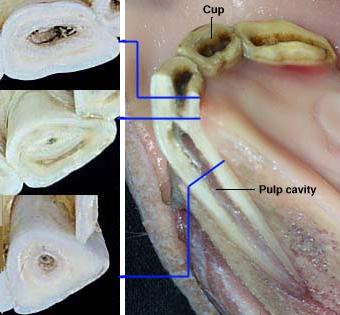
The incisors erupt from the center of the mouth to sides from around age 2 1/2 to age 4 1/2, twelve in all.   These teeth have cups in the top that gradually wear smooth and lighten, then disappear, in a specific order age the horse ages.

image from www.vivo.colostate.edu


Age of disappearance of cups.
.

An example of teeth at 7 and 10 years.


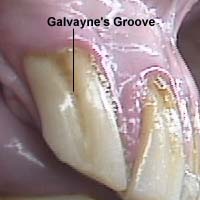
After age 11 all of the cups have disappeared so you have to use the angle of the teeth and Galvayne's groove to make an estimate.  Galvayne's groove is a dark groove that forms in the upper corner incisor teeth.

Image from www.vivo.colostate.edu


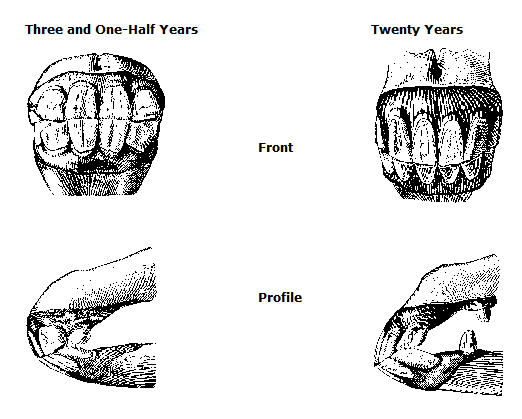
It starts growing from the gumline at about age ten and reaches halfway down the tooth at about age fifteen.  (This is how I would know Casey is fifteen if I didn't have his papers.)  In another five years, at age twenty, the groove should reach the bottom of the tooth.  At age twenty the groove also starts to recede from the gum line, is halfway gone at age twenty-five and completely gone at around thirty years of age.  If you can't find a groove, you can judge by the angle of the teeth whether the horse is ten or thirty.   The more severe the angle and longer the tooth, the older the horse!


So now you know where the terms "long in the tooth" and "never look a gift horse in the mouth" come from!

Thursday, February 10, 2011

Smile!


Toby is demonstrating the "Flehmen Response" for us here.  This action is used by horses and various other animals, including your household cat, to more closely examine scents.  The movement of the upper lip helps expose the vomeronasal organ and draw scents into it.  The vomeronasal organ is thought to be used to detect pheromones which would explain why the "Flehmen Response" is most commonly seen in stallions near mares in heat.

Horses may also grimace like this if they are in pain, usually associated with colic or other abdominal discomfort.  So, if you you see your horse smiling at you from the field make sure that he is just having a good sniff!