Showing posts with label Medical. Show all posts

Saturday, April 7, 2012

Yo! Check Out My Crib


This horse is cribbing, also known as wind sucking.  It is a vice that, once learned, is virtually impossible to stop.  It usually develops as a result of boredom or frustration, but it can also be learned from other horses.  It is quite common in horses that stand in stalls or small paddocks for extended periods of time.  It is thought that the locking of the jaw releases endorphins that can cause a sensation of pleasure.

Cribbing can lead to colic or digestive upset caused by an excessive amount of air in the digestive tract.  In general cribbers are difficult to keep weight on, either because they would rather crib than eat or don't eat due to digestive disturbances.  Cribbing can also cause the front edge of the incisors to wear unnaturally.
One type of cribbing collar

The only real "cure" for cribbing is the use of the "cribbing collar".  It is a strap that is placed on the neck just under the jaw that prevents the horses from locking it's jaw.   Cribbing can also be reduced by giving the horse more turnout and having pasture or hay available at all times to prevent boredom.


Wednesday, January 25, 2012

Breakthrough in Equine Healing

I was recently going through a backlog of my horse magazines from the past few months.  I came across an article on a therapy that employs a horse's own blood to reduce inflammation and promote healing.  It is referred to as IRAP.

Many horses suffer from joint pain or osteoarthritis at some point in their lives as a result of an injury or old age.  There are various treatments available to help ease the pain, but some horses don't respond well to any of them.  If an injury is extensive or the body can't repair itself fast enough, it can be difficult to keep inflammation down which can cause more damage to the joint.

This is how IRAP works:
The vet draws 50ml of the horses blood into a special syringe containing glass beads.  The white blood cells recognize these beads as "foreign".  They adhere to the surface of the beads and produce anti- inflammatory and regenerative proteins. 
Right: Whole blood, Left: Blood w/serum separated

The syringe is put into an incubator for 24 hours, then spun in a centrifuge to separate the serum (clear fluid containing proteins).  The serum (called autologous conditioned serum (ACS)  because it contains high levels of anti-inflammatory proteins) is drawn off and divided into 4-6 doses which are administered at 1-2 week intervals.
The ACS works with the anti-inflammatory proteins already in the body to create a one, two punch and take the swelling down.  This therapy can be expensive, but because it is made with the horse's own blood there are very few adverse reactions as opposed  to regular treatments.

Tuesday, September 27, 2011

Lessons Learned from a Dentist

I have been a horse owner for over 35 years and I would like to think know more than your average Joe about my equine friends.  So I am always excited to find out something new about them. 
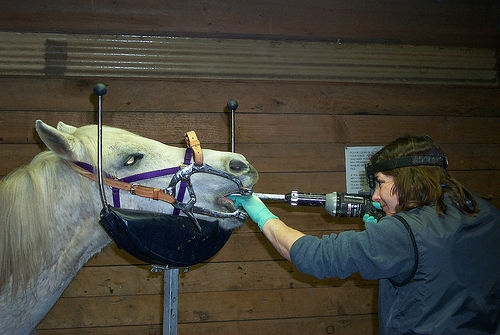
An equine dentist at work

Horses teeth grow constantly and can grow sharp points on their molars which need to be filed down in a process called "floating".  Yesterday I had the equine dentist out to "float" my boys teeth.  He also looked at their incisors, said they both had a very good bite and that they must get regular turnout on pasture.  What I never realized, but if you think about it it should be common sense, is that their incisors grow at the same rate.  Grabbing and ripping out grass is how they wear them down.  My horses have always had access to pasture so it never dawned on me that horses on a hay/pellet diet don't use they incisors as much and often have trouble.

Yet another reason for keeping horses as natural as possible!

Friday, January 14, 2011

America's Obesity Problem

I just saw an ad for a weight loss system for dogs. Seriously?

Yes, Science Diet has a new weight loss system for the portly American canine. It claims a 94% success rate in the first thirty days. It comes with pre-measured meals (because apparently measuring one cup twice a day is too much for some people) and...wait for it...pre-measured "snacks". Do dogs need snacks?

FEED THEM LESS! My dog gets a cup of dog food in the morning and one in the evening and maybe a cookie in between. She still looks at me like she is famished, but that is all she gets! I would love to give in to those sad eyes, but I love her and want her to live as long as possible. She would eat until it came out of both ends (which happened once when she was left home alone with a ten pound bag of cat food). That is what dogs do! It is up to us to stop them from blowing apart. The woman in the ad says "this weight loss system is easy!". Of course it is! Its like having a pet, but without all the nasty responsibility of actually having to care for them. Its one thing if you can't stop yourself for over-eating, since we don't keep our food locked away in a bin in the kitchen, but, please, have some self control for your pets!

Sunday, January 9, 2011

Horses Drool!

So lets talk about drooling horses today.  Drool can be both good and bad.  If you are riding dressage drool is good.  It shows that your horse is responding to the bit.  White, frothy, and dripping, the more the better!  It is not uncommon to see a horse in a grand-prix test with masses of white froth on their chests.

You should also expect to see a certain amount of drool while a horse is eating, even fairly dry foods such as grain or hay.  Its when your horse has that frothy "dressage" drool and is standing in the corner of the stall that you have problem.

Black Patch is a fungal disease that affects red clover,  the plants develop black lesions on their leaves, which will cause excessive drooling in horses if ingested.  Optimum conditions for its growth are rainy days with high humidity.  It can be ingested in the pasture or from hay that contains the infected plants.  So it is wise to know where your hay is coming from and inspect it closely.  Horses will recover quickly once the causative agent is found and removed.

If you have checked your fields and hay and can rule out Black Patch, then it is probably a tooth problem.  It may be as simple as a a piece of hay stuck in the gum line or something more serious like an abscessed or infected tooth.  Either way, it is probably time to call the vet.  They can flush the horse's mouth out to remove an offending object or worst case,  put the horse on Sulfamethoxazole (SMZ), or similar antibiotic if they there is an infected tooth.

Just know that horses do drool, but it is up to you to determine a cause!