Thursday, May 5, 2011

How to Build a Tack Trunk, Part One

My niece is 12 years old and has the horse bug just as bad as I do.  One of her first words, actually, I should say one of her first signs, was horse.  You see she was born profoundly deaf and could only communicate through sign language for the first few years of her life.  My brother, seeing that there was not a lot of early intervention programs for children with hearing loss in our area, started The Decibels Foundation to raise money to help pay for such programs.   This year they are holding their second annual horse show and I decided to make a tack box to donate to the silent auction.

This is how I went about it:

I used some 3/4 inch birch veneer plywood, cut out front, back and side panels for the basic box and routered the edges.
Using some small brads nails and wood glue I put together the basic box shape.
I added some trim to the inside so I would have something to nail the floor to.  Then I cut and attached the floor.
 I attached some 1 by 3 for the base trim and...
 ...a 1 by 2 for the top trim.
Added some corner trim to the sides.  Then countersunk any nails, filled the holes with wood putty, and sanded for a neater look.
I attached some thin pieces of wood to the inside corners as guides for the small storage box and brush box I will be making in part two.


Then using more 1 by 2  and some 1/2 inch birch veneer plywood I built the lid.
I stained the whole thing and attached the lid with a piano hinge.
Added a latch and some handles and the basic trunk was finished!

Stay tuned for part two...


Tuesday, April 26, 2011

What is a PMU horse?

Many people don't know that there is a large industry that gathers Pregnant Mare Urine (PMU) for the hormones to use in hormone replacement drugs for menopausal women.   It is marketed under the name of Premarin.  PMU farms have hundreds of mares that they breed and hook up to collection devices in very small stalls for the last six months of their pregnancy.   They are taken "off-line" just before foaling and allowed to foal outside in open fields, but they are bred again shortly thereafter.  These mares are kept like this year after year, producing foals that no one wants, until they are no longer productive, then they are discarded.   Most of the foals are discarded as well,  a few fillies are kept to replace older mares, the rest of the fillies and most of the colts are sent to slaughter.  A filly foal has a less than 1 in 10 chance of not going to slaughter, a colt foal has a less than 1 in 50 chance.   Some of these foals are saved by rescue organizations.  My friend Toby was one of the lucky ones.
 Toby made the trip down from Manitoba when he was about 6 months old.  He and 47 other foals were taken in by a rescue group who quickly found themselves overwhelmed.  So Toby and 16 of he friends went for another trip to the MSPCA Nevins Farm.  After a few months of care there, he was ready to be adopted.  That is where I found him.  

The PMU industry has gotten smaller in recent years.  Stricter regulations and greater awareness of where Premarin actually comes from have had many farms throwing in the towel.  The problem of these unwanted foals still exists, though, and will until there is no longer a demand.  There are only so many homes for these foals so, please, think twice about taking Premarin.


Wednesday, April 6, 2011

Blanket Statement

Well, its that time of year again.  Time to bring in all the horse blankets to wash and waterproof them for next year.  I am not big into blanketing my horses.  I believe that horses are healthier when they are left the way nature intended.
Toby in full winter fuzz
That being said, my horses do have three blankets each, a cooler, a heavy winter blanket and a lightweight rain sheet. There are occasions when blanketing is necessary.   I use the cooler, or lightweight moisture-wicking polar fleece, when they have gotten wet in the cooler weather.  For example if they have been running around and worked themselves into a sweat  or they have been out in a light snow storm or cool shower.  The polar fleece keeps them warm but allows the moisture to escape.  I also use the cooler in the fall to keep Casey warm on those cool fall nights.  He tends to be slow in growing his winter coat and as a result I have gone out several mornings to find him with a case of the shivers.

Casey in his heavy winter blanket
Their winter blankets I use even more sparingly.  I only really break them out when it is going to be under 20 F for more than a day or two.  Even then I don't always blanket Toby since he grows an extraordinary amount of hair.

Toby and Casey sporting their lightweight blankets
The lightweight rain sheet is what I use the most.  They wear them mostly in the spring and fall when getting wet to the skin can cause a chill or when "rain rot" can be a problem. 
Rain Rot


"Rain rot" or "rain scald" is an anaerobic skin infection that causes crusty scabs and matted tufts of hair.  The bacteria love a humid,  oxygen-free environment which happens when moisture is captured under a thick winter coat.  Treatment requires baths with antimicrobial shampoo (usually daily for about seven days) until the infection clears, but it is easy enough to prevent if they just wear their raincoats.

Wednesday, March 30, 2011

Mr. Bluebird

I cleaned out my Bluebird boxes today in anticipation of spring nesting.  It is important to do so since Bluebirds, unlike my friends the Phoebes, will not use the same nest as last year. 
Eastern Bluebird
I built two boxes a couple of years ago, but only hung out one the first year.  I didn't finish them until May and by then it was too late in the season for Bluebirds since they start nest building as early as February.  I did, however, get some tenants that first year.
A pair of Carolina Wrens made a pretty little nest of small twigs and raised a brood of three.
Carolina Wren
 Last year I finally got a Bluebird pair to use the box.  They only had one brood and not until late summer, but they made a beautiful nest with soft moss on the bottom and pine needles on top.  I saw a group of five bluebirds early this winter sitting in the trees near the barn.  I thought they were just looking to see what houses were on the market for the spring, but it was probably my Bluebird family.  Apparently, if a pair hatches a brood late in the season they will stay together as a loose knit family unit through the following spring.

If you are interested in attracting Bluebirds to your property there are a mired of nest box plans on the internet.   I used this one  because it involved cutting up just one 1X6.  There are many "rules" about where to mount the boxes so be sure to read up before you start hanging them. 

Wednesday, March 23, 2011

They're Baack!


 Spring is finally here!  How do I know that?  No, not because March 21st has just past, but, because the Phoebes are back! 


We have lived here almost 7 years and each summer we have a pair of Eastern Phoebes that board with us and raise 2 or 3 clutches of chicks. 
Phoebes are one of the first birds to return in the spring and hearing their "fee-bee" song in mid-March makes me think warmer weather is just around the corner.  They mate for life, are loyal to their nests, and can live up to ten years.  I'm not sure if this is the same pair that returns year after year, but they head straight to the barn like they know where they are going.  They set up house in the rafters above Casey's using moss, mud, and a few horse tail hairs.

Momma sets for two weeks and the chicks are ready to fly two weeks after that.  They grow up so fast!  I love to watch the chicks head pop up out of the nest and see mom and pop relentlessly flying in and out with bugs.  I hope they don't decide to move out now that Owen has moved in!

Sunday, March 20, 2011

Feelin' Groovy

Casey turned fifteen this past week.  I know that because I have his registration papers, but if I didn't I would still have a rough idea of how old he is by looking at his teeth.  Horses teeth change very distinctly as they age.  They start getting their permanent incisors (front teeth) around age 2 1/2.  The image below shows a horse who has probably just turned three.  The four teeth in the middle are the permanent teeth which have wider bases and tend to be more yellow than the deciduous baby teeth  on the sides.
http://www.ecmagazine.net/images/sp04/teeth3.jpg

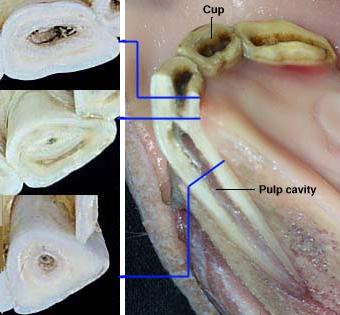
The incisors erupt from the center of the mouth to sides from around age 2 1/2 to age 4 1/2, twelve in all.   These teeth have cups in the top that gradually wear smooth and lighten, then disappear, in a specific order age the horse ages.

image from www.vivo.colostate.edu


Age of disappearance of cups.
.

An example of teeth at 7 and 10 years.


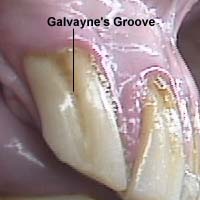
After age 11 all of the cups have disappeared so you have to use the angle of the teeth and Galvayne's groove to make an estimate.  Galvayne's groove is a dark groove that forms in the upper corner incisor teeth.

Image from www.vivo.colostate.edu


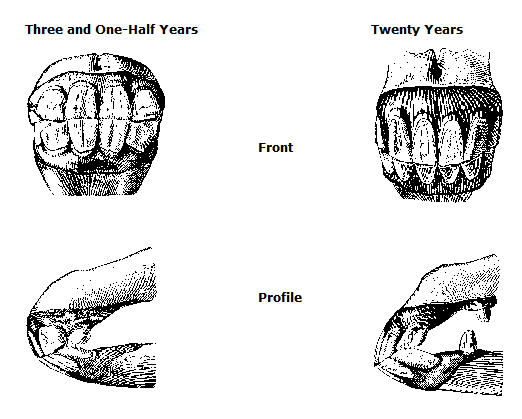
It starts growing from the gumline at about age ten and reaches halfway down the tooth at about age fifteen.  (This is how I would know Casey is fifteen if I didn't have his papers.)  In another five years, at age twenty, the groove should reach the bottom of the tooth.  At age twenty the groove also starts to recede from the gum line, is halfway gone at age twenty-five and completely gone at around thirty years of age.  If you can't find a groove, you can judge by the angle of the teeth whether the horse is ten or thirty.   The more severe the angle and longer the tooth, the older the horse!


So now you know where the terms "long in the tooth" and "never look a gift horse in the mouth" come from!

Thursday, March 10, 2011

My new pal, Owen


Meet my new pal, Owen.  He is the newest edition to the family, the barn cat.  I adopted Owen from the MSPCA which has a "Barn Cat"  program that helps save the lives of cats who may not have other options.  These are cats that have been deemed "unadoptable" for various reasons.  Some are feral, some have litter box issues and others just don't adapt well to life indoors.   Owen, here, was said to be too frisky when left indoors, but I haven't seen any evidence of that. 


 So far Owen has been the perfect gentleman.  He comes to greet me at the door, loves to be petted and will even sit on my lap and purr.  Hes not just a pretty face though, he does have a job, unlike the three lazy cats house cats.


Owen's job is to keep the area rodent free.  This winter has been chock full of mouse activity in the barn.  They have chewed through anything and everything!  Toby's lightweight blanket has a two inch wide hole in it,  one of my riding gloves is missing a finger, two of my lead ropes have had the snaps chewed clean off, and they have left little "presents" everywhere.  It was high time to do something about the infestation.   That is why Owen has joined the family.

The MSPCA is a wonderful organization that really tries to match the animals in their care with the best possible home.  I am a repeat customer.  Toby and two of my house cats have been adopted from Nevins Farm.  If you have a barn and could use a little help with your rodent population, please check out the MSPCA's "Barn Cat" program.  Barn cats cost nothing to adopt and you can help a cat the otherwise would not have a chance.